8:3 - the mealworm chair man takes on tatami | interview with biodesigner Will Eliot
What if storytelling isn't just how we present our finished work, but how we create it?
While immersed in creation, I often don't know what my work is about until it's nearing completion. As I touched on in the last issue, I typically connect the dots afterwards – partly because meaning emerges through making, partly to protect that emergent process from being prematurely affected by concerns about others' reactions. But what if there's another way?
For designer Will Eliot, storytelling and authenticity aren't at odds. He draws on his advertising background to weave the narrative in from the start. His practice of biocollaboration – working with living organisms like mealworms as design partners rather than just materials – mirrors his storytelling approach: organic, integrated, symbiotic.
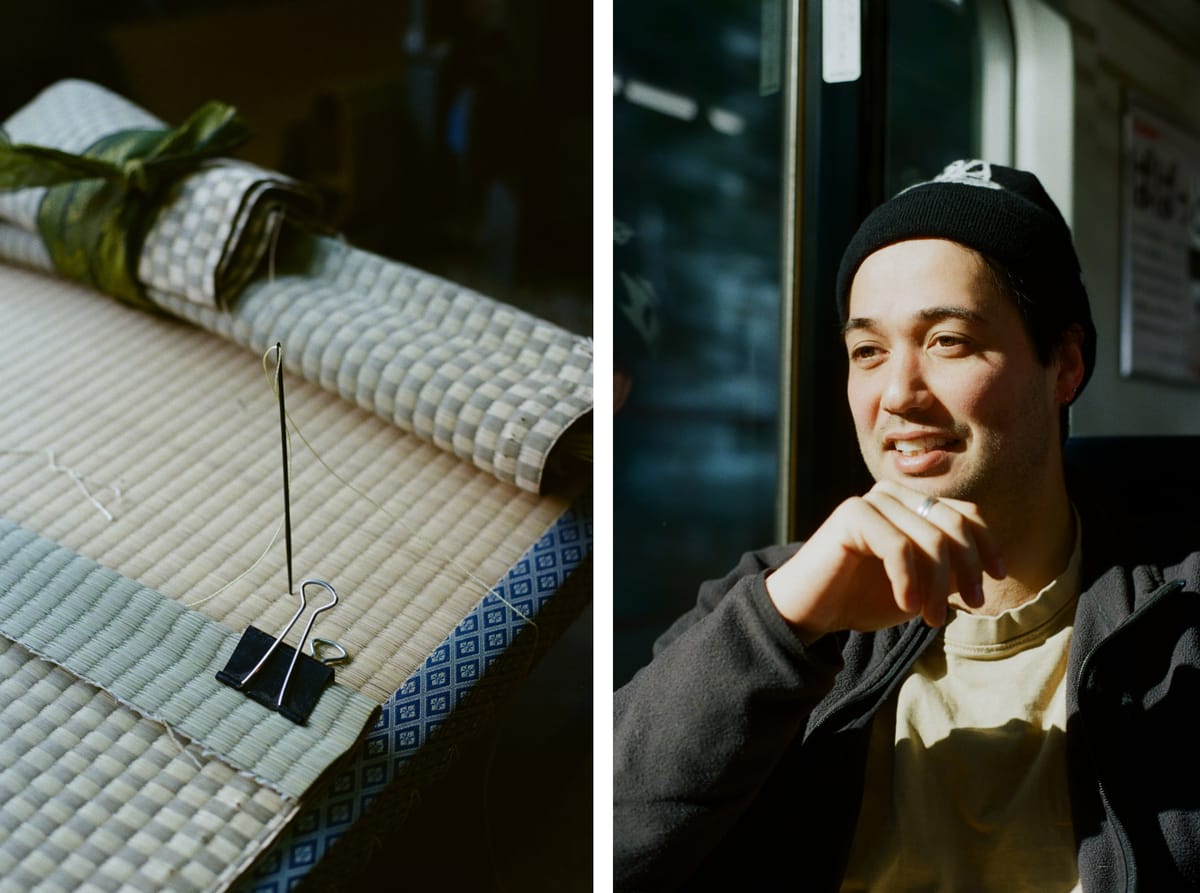
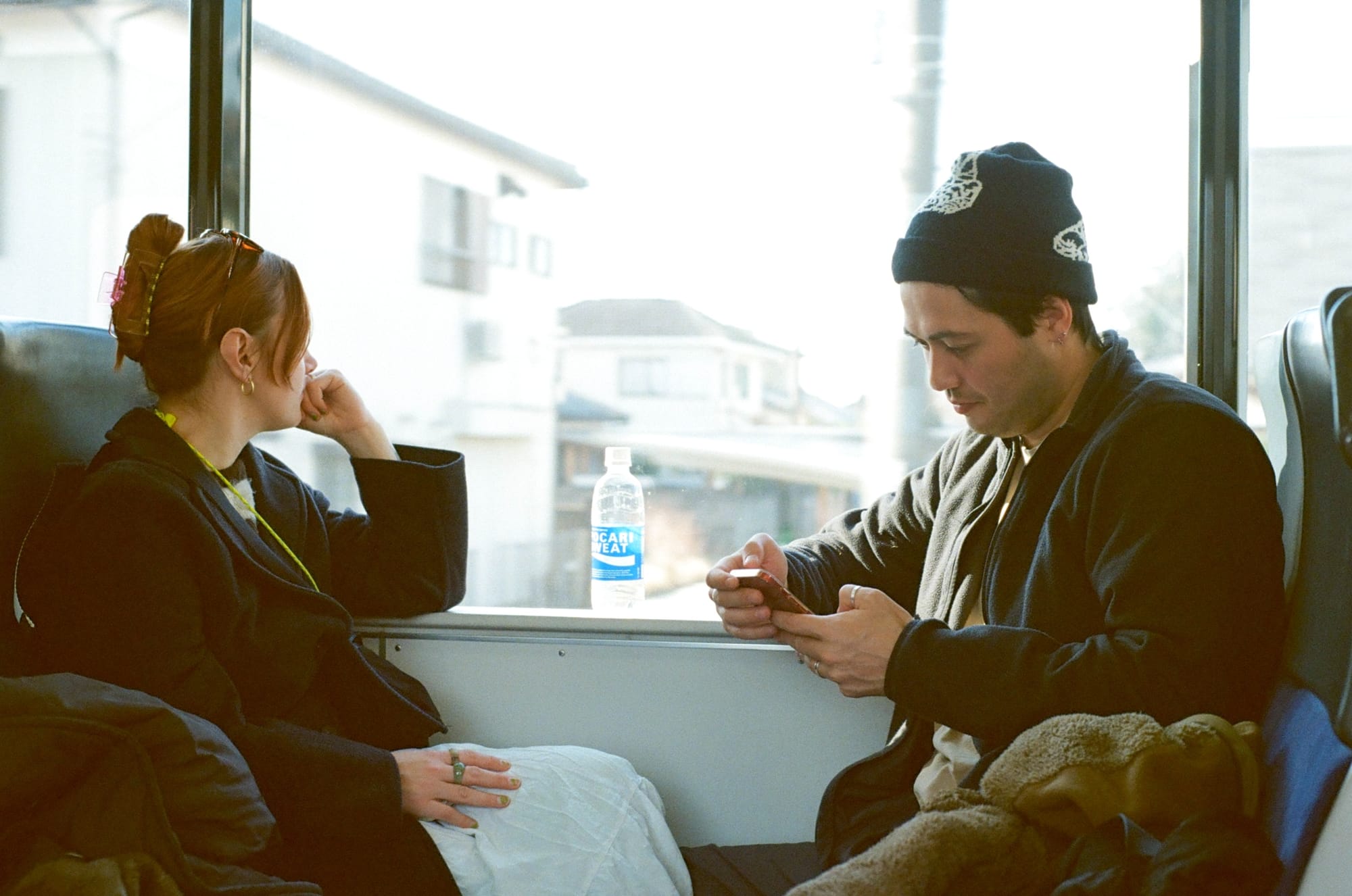
I've been admiring his work from afar, so when he invited me to join him and his partner Cordelia for a tatami workshop in Saitama a few months ago, I didn't hesitate. We learned about the components of a tatami mat and practiced three stitches to weave the mat's top layer. Later, over curry in Toritsudaigaku, we explored his philosophy more deeply. Our conversation unfolded with some surprises (a sudden power outage in the restaurant) and discoveries, much like his design process.
You’ve got your advertising hat and your designer’s hat. How do they work together?
I never go from making work, then switching to thinking about how I’m going to tell the story. For me, the story and the work inform each other throughout the process.
At design school, I was surrounded by smart, introspective designers, but they often struggled with presenting their work in a compelling way. They'd often explain the steps they took: “we did this first, then this, then this.”
I think it’s important to ask: Why does it matter? What's the cultural insight? Where is the emotional tension?
For my project it's: What would the world look like if mealworms were our collaborators? Off of that provocation, I could explore what a mealworm-powered waste facility looks like, or a future where humans are capable of digesting polystyrene too. I don't know if I could ever pull off those projects, but it opens up a series worlds I could develop.
You presented that mealworm project on TV in the UK for a broad audience. To prepare for that, what different story angles did you consider?
Looking back at that TV appearance, I think my explanation was a bit too technical. I said, “Wouldn't it be so cool if we collaborated with mealworms?” but I forgot to mention the reason why it's interesting is that 30 percent of landfill volume is polystyrene and it can't be recycled in most places. I should have made that really clear.
I went into this artistic designer mode, which has merit, but I'm at this intersection of art and design. It's hard to find the balance between going too rational that you lose a bit of the magic, or going too artistic. I like both sides.
Emile de Visscher, who graduated from my course a decade ago, did a project where he took a grain of sand on a pendulum that moved vertically so it would be dipped into a salt solution, replicating how oysters naturally make pearls. That’s an inefficient way to make a material, but it's also interesting to recreate a biological process slowly. Does it make sense to have a whole factory of these making pearls over the course of three years? Probably not, but it asks a lot of questions. Could we be recreating other found materials in different ways?
Mealworms aren't going to design all our furniture in the future, but they could be a part of other things that we're currently keeping them separate from. By having these radical collisions between nature and design, you don't always end up with a scalable startup idea, but they might inspire someone else to keep exploring, which is equally important.
I admire how you’ve identified an overarching theme in practice of collaborating with nature through a methodological, but open-ended process. I struggle to find the “connecting factor” in my own projects, which sometimes makes me feel like I’m scattered or losing momentum.
For you it's so personal; the way you write and the content is from your own perspective. Life isn't a clean, straightforward narrative; it takes turns.
For me, that strong narrative is a double-edged sword – both helpful and limiting. I have ideas beyond biodesign that have to do with leaving Japan when I was 8 and growing up half Japanese in England. But what's that got to do with mealworms?
Art and being an artist are two different things. Art is what you want to make and feels true to you. But most commercially successful artists I see are a brand and a business. They'll make some departures, but can't change much otherwise. I would like to believe you can put out anything, but when applying for grant funding or seeking clients and commissions, a clear track record is so important to be able to say, "I'm a specialist in biodesign and I know how to move you into this area."
On the topic of projects beyond biodesign – you've been researching tatami. What sparked that interest? And what motivated you to join this tatami workshop?
I was a bit frustrated that biodesign felt so sterile. Weirdly, even though it's about nature, there are renowned designers like Neri Oxman and other studios, who I absolutely admire, but who present their work, story, and computational design methodology in a way that feels clinical and scientific.
It didn’t feel like me. I was thinking about what I wanted to discover about myself and I've always had this driving identity question after leaving Japan at eight and only returning in the summer.
This six week trip was my longest in a decade. I wanted to explore one craft and see how that might inform my design practice. In the past, I researched Japanese crafts like bamboo weaving, exploring supply chains, and how beneficial traditional methods of making are for the environment.
I was drawn to tatami because the materials (hay, rush, etc.) are often underappreciated and considered waste. A lot of renewable materials are expensive, so the price keeps you out of it, whereas you can get tatami quite easily. It’s a frugal innovation.
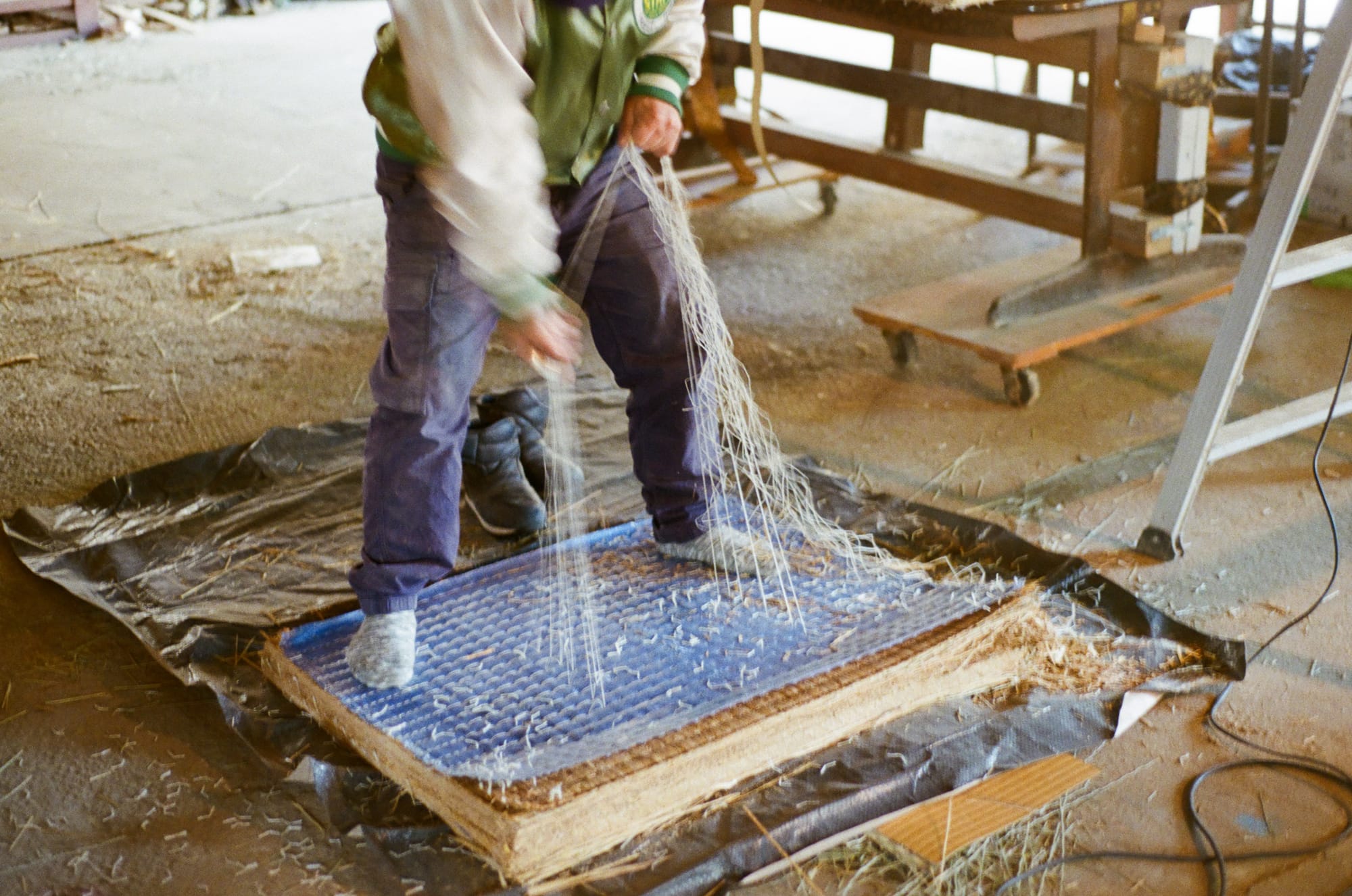
I was surprised when they cut the tatami mat open and showed us the dense layers of hay inside.
Yeah, it's just compressed hay, but so solid. The weaving adds strength too. I didn't know any of that before. Online, I'd read that a lot of it's cork, plastic, and polystyrene now.
I was surprised by the different components of the middle. The hay is stacked in a particular way. When they pulled it apart, it was like dust. There were multiple types of stitching. They are simple, but tried and tested methods, which some researchers like Julia Watson would call “indigenous knowledge”.
When I went into the workshop, I didn't have any ideas of what I wanted to do with tatami. Later, when I was at an onsen in Gunma, I noticed these beams on the onsen roof – huge logs that form a really strong structure. I started to wonder if you could turn the tatami into a log. Visually that resonated with me because there's a lot of 60s Italian designs that use simple geometries to make armchairs. This is still very much in the early stages though, so I’ll be experimenting a lot before the final product.
Your design process seems very experimental and iterative. How do you approach a new idea like that?
My work is iterative, so I won't necessarily know what the final thing is going to be, but I'll have a question or a line of inquiry.
I find really cheap, hacky ways of testing with things that have the similar material qualities. What happens if I wrap hay with igusa rush around the outside? Does it work? If not, what's going wrong? Previously, I would tried to make the final thing straight away, but it's so hard. By doing these little tests, you learn about the material, and about what's possible.
Maybe a cylinder doesn't work, but a triangle does. Something else emerges from it. It's messy. Exploring tatami is moving away from the scientific “biodesign” angle of my practice – usually, the biological process is much more ingrained into the final product. But at the moment, it's more about taking a traditional craft and then making it modern, which is fine, and maybe that's where I want to go. I don't want to shoehorn it in. I haven't figured out if it's a departure for the studio, or if there is a version of it that sits between the two.
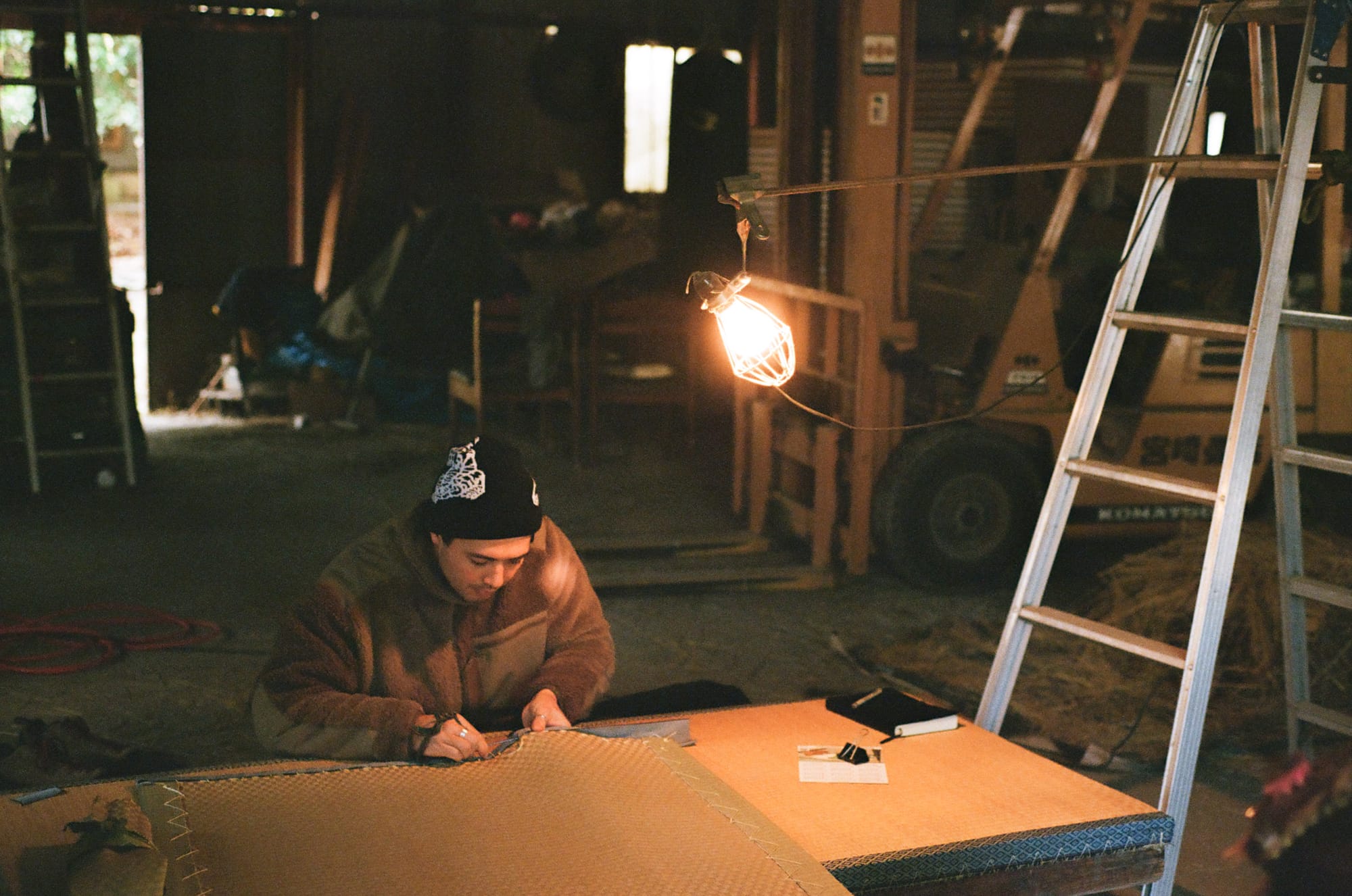
It's really driven by curiosity and imagining.
Yeah, definitely. When I visited the Ghibli Museum, I remembered that Princess Mononoke freaked me out when I was six. It was scary, but it really stuck with me. Nature's dangerous, but there's this whole magical element to it.
As we get older, we lose touch with it. Nature just becomes Biology – a science, or a thing we walk through and look at.
Insects are clever. Wood can move drastically if you put water on it in a certain way, which inspired a whole line of work. All my work is about trying to rediscover that magic.
For more:
- Check out Will's design studio biocrafting.studio
- Biocrafting studio's newsletter